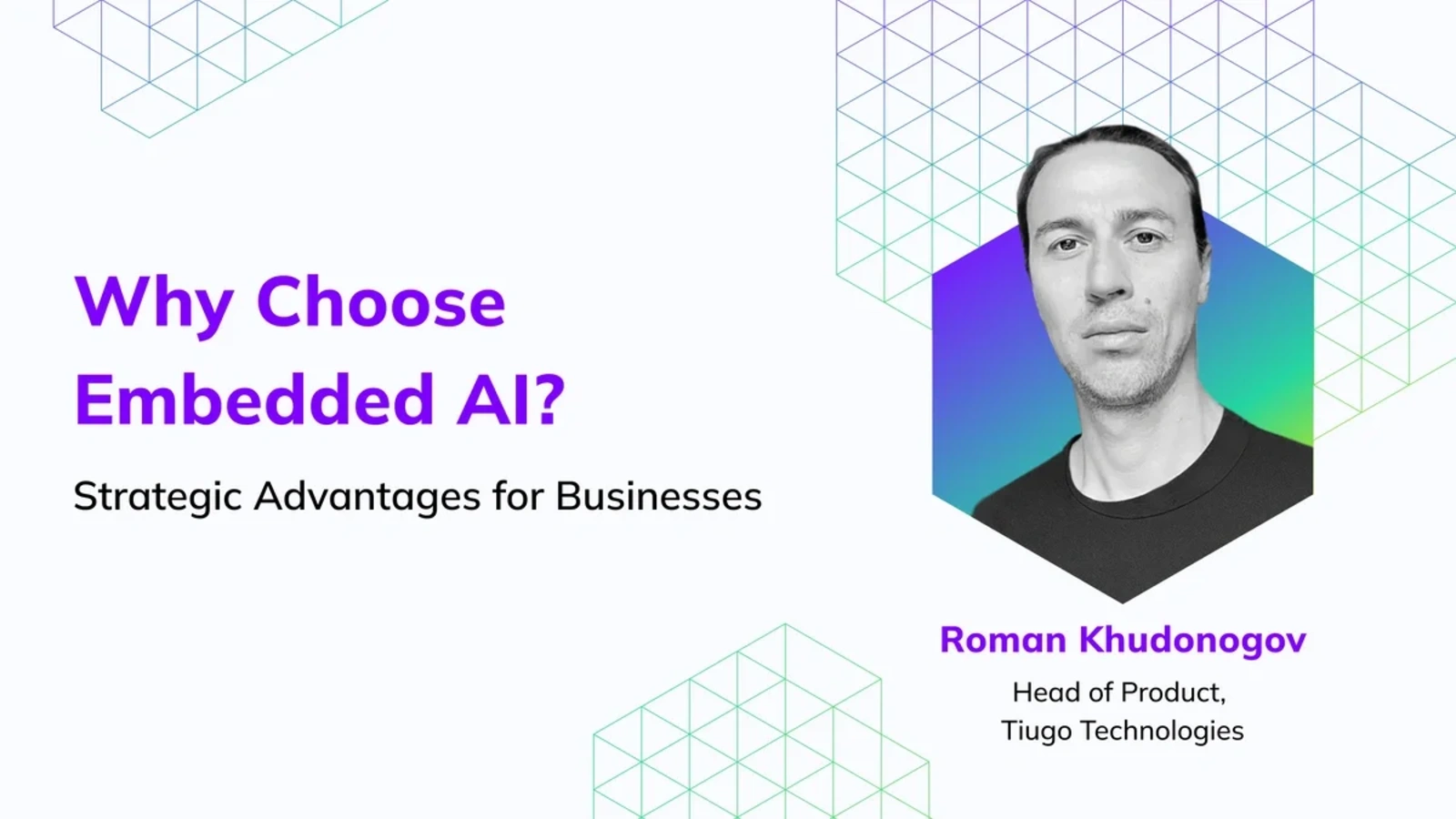
Why Embedded AI Wins Over SaaS Overlays
The generative AI revolution has arrived in the workplace, but not in the way most enterprises planned.
While ¾ of knowledge workers now use AI tools daily and 78% bring unauthorized “shadow AI” to work, toggling between ChatGPT, Claude, Gemini, or Grok in separate browser tabs and pasting results into business applications. This fragmented approach creates a cascade of problems such as lost formatting, broken tables, missing images, security vulnerabilities, and workflow disruptions that undermine the very productivity gains AI promises to deliver.
The solution isn’t to ban AI tools or simply give up and accept this patchwork approach. It’s to embed AI capabilities directly into the applications where content creation happens.
Embedded AI refers to artificial intelligence capabilities added directly into applications both in the frontend UI and the backend service. This article will explore why embedded AI provides superior strategic advantages to businesses compared with SaaS overlays.
CKEditor AI is available as an add-on in the Essential, Professional, and Custom plans.
Start a 14-day free trial or contact us to learn more.
The Hidden Cost of the Copy-Paste Workflow
On the surface, using ChatGPT or similar tools alongside your CMS, CRM, or documentation platform seems reasonable enough. But this workflow imposes significant hidden costs that accumulate with every use.
Content Integrity Breaks Down
When users draft content in standalone AI tools and paste it into rich text editors, critical elements disappear. Tables lose their formatting. Images and embedded media vanish entirely. Even basic text formatting such as bold text, headers, or lists often fail to transfer correctly. The result? Users spend valuable time reconstructing what AI just created, manually reformatting tables, re-uploading images, and fixing broken layouts. According to recent studies, 45% of employees report they would use AI more if it were properly integrated into their existing tools, a clear signal that current workflows fall short.
Security Risks Multiply
The “bring your own AI” trend introduces heightened enterprise risk. When employees route sensitive business data through personal AI accounts, they bypass corporate security controls entirely. Data exposure to AI tools increased 156% in just one year, with approximately 27% of chatbot inputs now classified as sensitive information. Whether it’s customer data, proprietary strategies, or confidential financial information, this shadow AI usage creates data governance nightmares that compliance teams struggle to contain.
Productivity Gains Evaporate
AI promises speed and efficiency, yet the copy-paste workflow undermines both. Every context switch between applications disrupts focus and introduces opportunities for error. Users must quality-check AI outputs, manually reformat content, verify that nothing was lost in translation, often starting over when the formatting breaks. What should take minutes stretches into prolonged editing sessions, erasing the time savings AI was supposed to deliver.
Embed [AI] to eliminate friction. Don’t make customers do the heavy lifting… Embed into existing workflows and add value right where your customers already are.*Saanya Ojha, Partner at Bain Capital Ventures
Why Embedded AI Changes Everything
Integrating AI writing features eliminates these friction points by putting AI capabilities in the content creation environment. Rather than using AI as a separate tool that requires switching between tabs and copy/pasting, embedded solutions make AI a native part of the editing experience.
Seamless Workflow Integration
With embedded AI, users never leave their primary workspace. They can draft, refine, and finalize content in one interface. All formatting, images, and structure gets preserved throughout the process. There’s no export-import cycle, no formatting repair work, and no content lost in translation. Because AI is in an editor, it can understand the context of the document, access relevant knowledge bases, and generate content that integrates easily with existing text while maintaining a consistent tone, style, and brand voice.
Enterprise-Grade Security and Governance
Embedded AI brings AI capabilities under the same security and compliance frameworks that already govern your business applications. Instead of data being passed to personal AI accounts on public services, sensitive data remains within your controlled environment. Enterprise implementations like CKEditor AI offer SOC 2 Type 2 compliance (CKEditor 5 is already SOC 2 Type 2 certified, and the upcoming SOC 2 report in Q1 2026 will also cover CKEditor AI), configurable access controls, and the ability to pre-approve specific AI models. This reduces the risk of shadow AI by turning AI into a governed, auditable capability.
Technical Simplicity and Faster Time-to-Market
Building strong AI capabilities in-house requires specialized expertise. Developers must be well-versed in large language models, prompt engineering, evals, and deep integration with editing frameworks, which is a rare and expensive combination. Even with AI-assisted development tools, creating enterprise-ready AI editing features would require months of development time and ongoing maintenance overhead.
Why CTOs Are Choosing Embedded AI: Strategic Advantages Beyond Features
For technology leaders, the decision between embedded and standalone AI goes beyond capabilities. They have to think about resource allocation, competitive positioning, and sustainable innovation. For CTOs to succeed with AI transformations, they must recognize that where you integrate AI matters as much as which AI you use.
Protecting Engineering Capacity for Differentiation
Your engineering team is your most valuable and constrained resource. Every hour spent building foundational AI infrastructure is time not spent building features to differentiate your product. The cold reality: building enterprise-grade AI editing capabilities requires rare expertise. So it makes sense to choose to buy solutions from a third-party vendor that offers the ability to have embedded AI in applications.
AI capabilities evolve at a breakneck pace. What’s state-of-the-art today may be table stakes in six months. DIY solutions require continuous reinvestment to stay on the cutting edge. Commercial offerings are backed by dedicated teams tracking model improvements, optimizing prompts, and handling the integration complexity of new capabilities. Every quarter your team spends maintaining AI infrastructure is a quarter your competitors spend building features customers actually pay for.
Accelerating Time-to-Market in the AI Era
Building from scratch means 12 – 18 month development cycles. By that point, the market will have moved on and your “innovative” AI features are just considered the norm. Embedding AI solutions compresses this timeline dramatically. With the right commercial solution, what would take quarters to build can be integrated in weeks, letting you ship AI capabilities while they’re still cutting-edge. This speed advantage compounds: faster deployment means earlier user feedback, more iteration cycles, and better end-user experience.
Equally critical, embedded solutions eliminate the technical debt that comes with rushed custom development. Your team doesn’t have to maintain hastily built AI infrastructure or retrofit security controls. Instead, you can rely on battle-tested commercial solutions that scale, have passed compliance certification processes, and provide vendor-managed upgrades. This means you can move fast without mortgaging your technical future.
Future-Proofing Your AI Architecture
The AI landscape will look dramatically different in 12 months. CTOs need AI architectures that adapt without requiring wholesale rebuilds.
Embedded AI platforms provide this flexibility by abstracting model complexity behind stable APIs and UI/UX. When the newest model emerges, vendors for embedded solutions already handle integration, testing, and optimization. When new capabilities like advanced reasoning or multi-modal understanding become available, they flow through existing integration points rather than requiring new architectural components.
You see this pattern across enterprise technology: those with winning strategies focus on integrating best-of-breed solutions that evolve independently. Just as you wouldn’t build your own database or authentication system today, building your own AI infrastructure makes less sense as commercial solutions mature. Focus your engineering investments on the application layer: that’s where value accrues.
Real-World Impact: Use Cases that Matter
Consider some examples of how embedded AI-writing features can speed up businesses and guarantee satisfaction to users and integrators across the board.
1. Content Marketing Teams
Embedded AI can help marketing professionals produce blog posts, landing pages, and email campaigns. Rather than drafting in ChatGPT and reformatting in their CMS, they can work in a single AI-enhanced editor with access to brand guidelines and approved messaging frameworks. This gives them the tools needed to produce on-brand content from the start. This can cut the content production cycle down from days to hours without sacrificing quality.
2. Technical Documentation
Documentation teams face unique challenges: technical accuracy requirements, complex formatting needs, and collaboration across multiple stakeholders. Embedded AI can help with initial drafts, suggest clarity improvements, and help keep consistency across thousands of pages, all while preserving the code samples and diagrams that standalone AI tools butcher. This allows documentation teams to maintain comprehensive, up-to-date content libraries that would otherwise require significantly larger teams.
3. Customer Support
Knowledge base software with embedded AI can help support teams draft answers to customer questions or update existing articles based on recent inquiries. The AI can draw context from the organization’s existing knowledge base to ensure accuracy. Because it’s embedded, the formatting and internal linking structure will remain intact, which is critical for findability and the end user experience.
The Path Forward
The copy-paste era of workplace AI is ending. As embedded AI solutions mature, the productivity gap between organizations using integrated AI and those relying on standalone tools will widen dramatically. The top technology leaders are moving quickly to implement embedded AI to gain the benefits without AI’s natural friction.
For content-heavy applications, the choice is straightforward. You can continue managing the risks and inefficiencies of shadow AI and fragmented workflows, or you can use deeply embedded AI to transform your application into an intelligent content creation platform. The organizations that move first will capture significant competitive advantages.
Ready to explore how embedded AI can transform your content creation workflows?
Start a free trial or speak with our sales team to learn how CKEditor AI delivers enterprise-ready AI capabilities integrated directly into your applications—no copy-paste required.
------
*Source