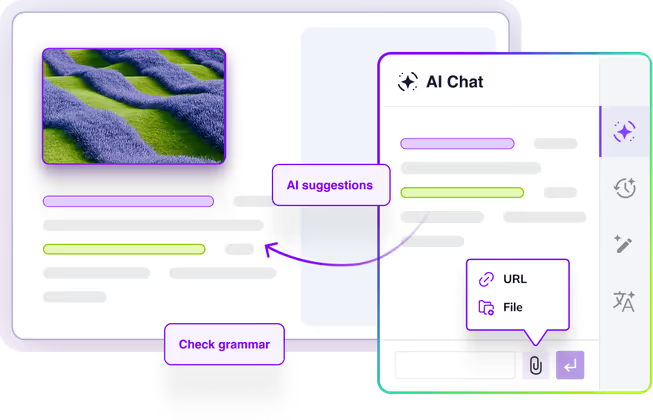
Bring AI where content happens
Enhance content creation efficiency and consistency by allowing your team to access the AI tools they
need directly within your editor. No more jumping back and forth between external AI platforms and
your app - CKEditor AI provides all the AI writing tools needed to optimize the modern content creation workflow.
AI Review
AI Translate
AI Quick Actions
CKEditor AI features
at a glance
In this demo you can test CKEditor AI hands-on. Start a chat in the AI side panel and use the chat history feature to switch between different document conversations. Use the Review feature to run grammar and style reviews, or use Quick actions, like rewriting and summarizing, directly on the text inside the editor.
Loading...
Customer Support Metrics Report
Operational Summary – Second Half of 2025
Overview
This report summarizes customer support performance during the second half of 2025. It focuses on ticket volumes, response efficiency and common issue categories, based on internal operational data across all support channels.
The information below should be treated as an overview of observed trends rather than a detailed performance evaluation.
Support Process Overview
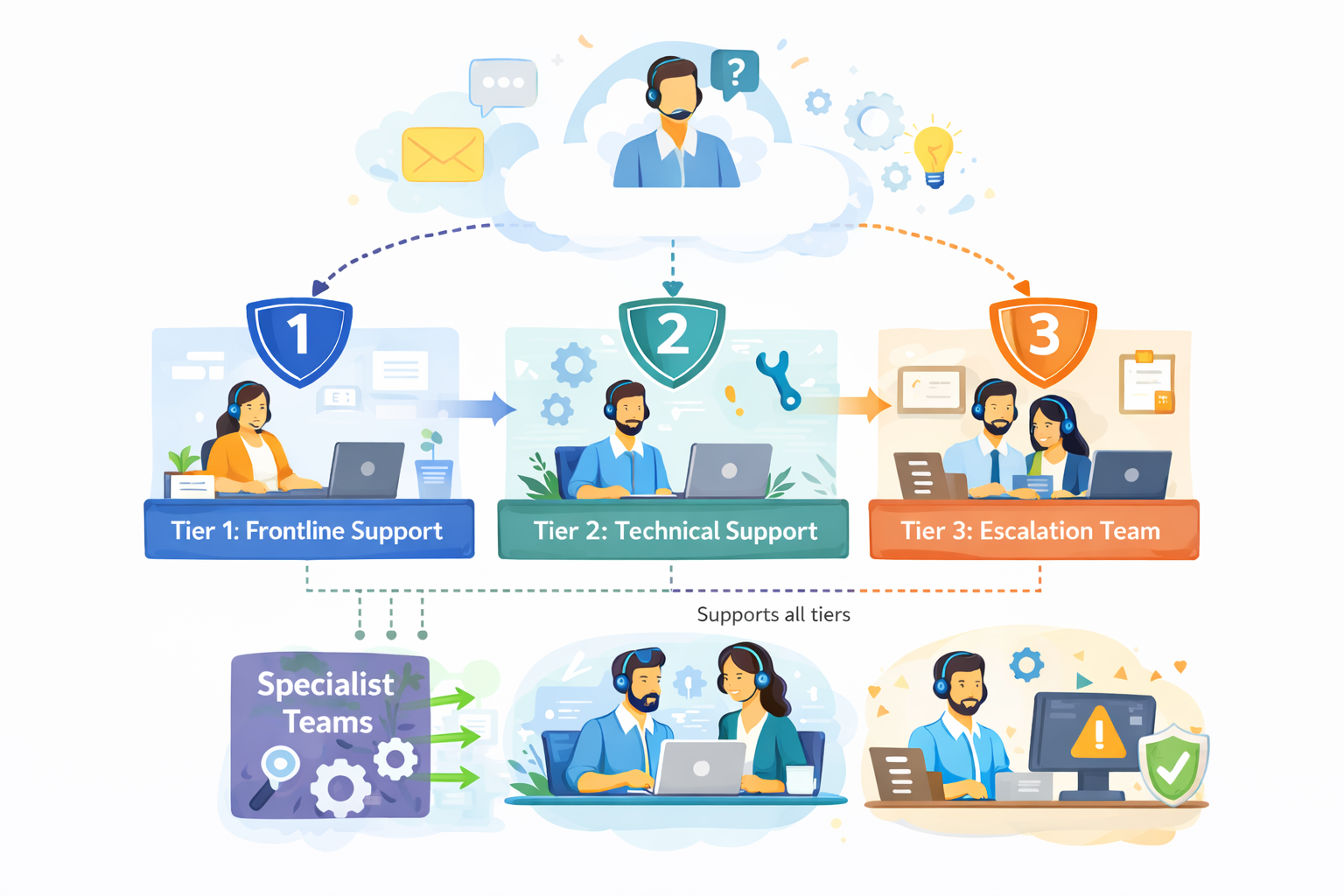
The diagram outlines our internal customer support process, showing how incoming requests are handled across multiple support tiers based on complexity.
Customer inquiries are initially managed by Tier 1: Frontline Support, which is responsible for triage and resolution of common issues. More complex cases are escalated to Tier 2: Technical Support, where deeper technical investigation is performed.
High-impact or unresolved issues are handled by Tier 3: Escalation Team, which coordinates with internal experts as required. Specialist Teams support Tier 2 and Tier 3 by providing domain-specific expertise, while typically remaining non-customer-facing.
The process is designed to allow flexible movement between tiers, supporting efficient resolution and appropriate escalation when needed.
Ticket Volume
During the reporting period, the support team processed 184,600 tickets, representing an increase of 11% compared to the previous period. Ticket volume peaked in September and gradually stabilized towards the end of the year.
The increase was primarily driven by onboarding-related questions and product configuration requests.
Channel Distribution
| Channel | Share of Tickets | Change vs. Previous Period | Avg. First Response Time |
|---|---|---|---|
| 54% | -3% | 3.1 hours | |
| Live Chat | 31% | +5% | 1.2 hours |
| In-App Support | 15% | -2% | 2.4 hours |
Email remained the dominant support channel, although live chat usage continued to increase, particularly among larger accounts.
Resolution Efficiency
Average response and resolution times showed minor improvement compared to earlier in the year.
- Average first response time: 2.4 hours
- Average resolution time: 18.7 hours
- Tickets resolved within 24 hours: 68%
More complex cases, especially those related to integrations, required additional follow-up and were not consistently resolved within standard timeframes. While faster response times were generally appreciated, qualitative feedback indicates that communication consistency played an equally important role in overall customer perception.
"Faster responses were helpful, but consistency in follow-up communication had a bigger impact on our overall experience."
— Enterprise customer, post-resolution survey
Common Issue Categories
The most frequently reported issues were:
- Account access and authentication
- Billing and invoice related questions
- Feature usage clarification
- Integration setup
- Performance-related concerns
Billing-related requests declined slightly, while integration-related inquiries increased towards the end of the period.
Customer Satisfaction
Customer satisfaction was measured through post-resolution surveys. The overall response rate remained stable throughout the reporting period.
- Average CSAT score: 4.2 / 5
- Survey response rate: 27%
Feedback most often referenced response time and clarity of follow-up communication as areas for improvement, particularly in cases involving multiple handovers or escalations.
Identified Bottlenecks
Internal review identified several operational areas that may require further attention:
- Delays in ticket reassignment for escalated cases
- Inconsistent categorization of incoming requests
- Limited coverage during selected regional peak hours
While these issues did not materially impact aggregate performance metrics, they were visible in individual case handling and customer feedback.
"The issue was eventually resolved, although it was not always clear who was responsible for the case during escalation."
— Key account feedback, quarterly review
Summary
Overall support performance remained within expected operational ranges. Most key indicators were stable, with moderate improvements observed in response efficiency. At the same time, the data suggests that further improvements in communication clarity and escalation handling could positively impact customer experience in future reporting periods.
Note
Read more about the AI capabilities in the documentation.
Check the source code for this demo.


What CKEditor AI
brings to your content workflows


AI infrastructure built for rich-text editing
CKEditor AI isn’t just a connection to an LLM. It’s an AI layer purpose-built to use with a platform for structured content editing, document workflows, and enterprise environments.
AI that understands structured content
This ensures CKEditor AI suggestions
work reliably with
Tables and lists
Headings
Links
Images
Track Changes
Custom features and structured content blocks
Built-in state management
for content workflows
AI interactions are more than just single prompts - they're a full, multi-turn conversation. CKEditor AI takes care of it all.
Conversation history
Uploaded context files
External knowledge
Document state
Multi-turn interactions
Visualization of AI-suggested changes
Advanced prompt engineering
with business logic
Sending user prompts directly to an LLM is not enough for an enterprise-grade content workflow.
Optimized system prompts
Feature-specific AI logic (Chat, Quick Actions, Reviews)
Structured response shaping
Multi-change and long-document optimization
Intelligent task splitting for performance
Quality control with LLM evaluation suite
Customize CKEditor AI
for your app
Get AI features fast with out-of-the-box defaults. Fine-tune prompts, connect MCP
tools, and tailor AI Review checks to your brand voice and guidelines.

Customizable look and feel
Adjust the CKEditor AI features on the frontend to fit your use case and application UI.
Choose from different UI placement models
Toggle, maximize, or hide on initialization
Choose how to display AI suggestions inside the editor
Customize the UI theme or replace it with your own
Compatible with leading AI models
and custom LLMs
Connect your own LLMs, whether they’re in the cloud, on-prem, or from an external LLM provider.
Access the latest AI models, kept up to date automatically with the SaaS distribution of CKEditor AI.


CKEditor AI on-premise distribution supports custom models and your own API keys to the widely available ones.
AI cost control and observability
Manage and control AI costs and prevent them from spiraling quickly.
Prompt result caching to avoid redundant calls
Smart rate limiting
Delegation to faster/cheaper models where appropriate
Model flexibility without LLM
vendor lock-in
Future-proof your application with effortless adaptation to the constantly evolving AI landscape.
Easy switching between models
Unified output format compatible with CKEditor
Fallback chains if a provider goes down
Continuous quality control with
LLM evaluation suite
Ensure consistent, production-ready model performance without introducing risk,
as every model is tested via a proprietary evaluation suite.
Benchmarking models on real CKEditor use cases
Validating output quality and formatting integrity
Ensuring regressions are caught before deployment
Enterprise-grade security and safety
On-premises deployment option: CKEditor AI can be deployed on-premises for organizations with strict compliance and data-control requirements.
Content moderation: Every request is screened for inappropriate content before reaching the model.
Permissions system: Granular control over user, feature, and model access.
Encryption at rest: All conversations, documents, and uploaded files are encrypted, including in on-premises deployments.
Resilience and reliability: Rely on provider fallback chains, stream error recovery, and automatic retry strategies.
Constant evolution: Benefit from ongoing improvements to prompts and logic, support for new models and APIs, and adaptation to new AI standards.
Business partnership program
Want to have your say in CKEditor AI product development? Partner with us to develop the AI content editing framework aligning with your use case.
Early access: Start using the new features ahead of general availability.
Faster feedback loops: Provide direct input to our team, helping shape feature priorities.
Engineering support: Collaborate with our engineering team to streamline-implementation and resolve technical challenges.
Why CKEditor AI?
Introduces an all-in-one AI-driven editing experience and review process inside your application without friction
Increases team productivity by reducing manual editing, review cycles, and context-switching delays
Enhances content quality, clarity, and brand alignment across large teams
Saves the costs of months of research and development by introducing drop-in AI writing features inside your app
Future-proofs the content pipeline with scalable AI features that evolve with your business goals
Offloads operational burden and reduces the workload of AIOps teams
Reduces costs associated with external copyediting, QA, or manual rewrites
Speeds up publishing turnaround times and supports instant content personalization
Preserves organizational knowledge and reduces duplication with persistent AI chat history
General & Product
What is CKEditor AI?URL Copied
CKEditor AI is a set of in-editor configurable AI features—AI Chat with chat history, AI Quick Actions, and AI Review—that enhance writing, formatting, and reviewing content.
Can I control what the AI changes?URL Copied
Yes. All AI-generated changes are reviewable as suggestions before they’re applied.
Does it work with our existing CKEditor setup?URL Copied
CKEditor AI is designed as a drop-in, out-of-the-box component for applications using CKEditor 5. See the implementation guide for details.
I am already using CKEditor AI Assistant. Do I have to migrate do CKEditor AI?URL Copied
CKEditor AI Assistant will still be available and maintained for our current customers. However, if you’re looking to implement a more robust set of AI writing features inside your application, then CKEditor AI is the way to go.
Pricing & Licensing
How much does CKEditor AI cost?URL Copied
CKEditor AI is offered as an add-on to existing editor plans, using a simple and scalable subscription-plus-usage pricing model. Customers choose from three service tiers, each with a fixed monthly or annual fee that includes a credit allowance for AI-powered actions. If customers exceed their monthly allowance, predetermined overage fees apply.
How can I know how much a specific CKEditor AI operation would cost in terms of credits?URL Copied
This comparison table will help you navigate the credit usage for different LLMs and specific operations.
Technical & Security
Is there a CKEditor AI on-premises distribution?URL Copied
Yes, you can ship CKEditor AI on-premises. Find out how from CKEditor AI documentation.
Which LLM providers are available and which models can we use in CKEditor AI?URL Copied
We start with models from three major providers: OpenAI, Anthropic, and Google Gemini. The LLM market evolves rapidly, so CKEditor AI has a built-in mechanism for the introduction of new models quickly, as long as they can support the features of the editor.
Can I use my own API keys or custom LLMs?URL Copied
Yes, it’s possible with the on-premises installation. Find out how from CKEditor AI documentation.
Does CKEditor AI support MCP tools and RAG?URL Copied
Yes, with the on-premises installation you can connect MCP tools and enable retrieval-augmented generation (RAG). Find out how from CKEditor AI documentation.
Can I use my custom commands from the original CKEditor AI Assistant?URL Copied
The original AI Assistant is similar to Quick Actions in CKEditor AI. However, you can transfer AI Assistant actions to CKEditor AI.
Is my data used to train LLMs?URL Copied
No, it’s not. We take your data privacy seriously and never train our own models on your data. Your data remains yours.
Where is my data stored and how is it processed?URL Copied
Everything is stored in CKEditor Cloud Services and follows the same rules and patterns as other data we store for the editor features. For a full security breakdown, please visit the security section on our homepage. However, bear in mind that your queries to LLMs, together with all the data required to perform the operation, are processed by the selected LLM provider.
How can I monitor the activity of my users and their usage?URL Copied
Customers can use the Insights Panel to access Audit Logs after turning them on in customer portal settings.
How can I see the number of tokens each of my end-users are consuming when using the AI functionality?URL Copied
Our business logs contain information about the credits usage per request, including user IDs. Logs can be accessed in the Insights Panel in our Customer Portal and are also available via our Insights API.
Consuming data from Insights API should allow tracking of high-level usage trends in their application to prevent significant overusage or abuse, but it doesn't guarantee 100% accuracy so it should not be used as input for any precise, usage-based billing logic.
Bring AI where content happens
Whether you’re building content automation tools or regulated documentation workflows, CKEditor AI reduces the friction between ideation, creation, and compliance without forcing you to maintain an AI stack outside of your application.
